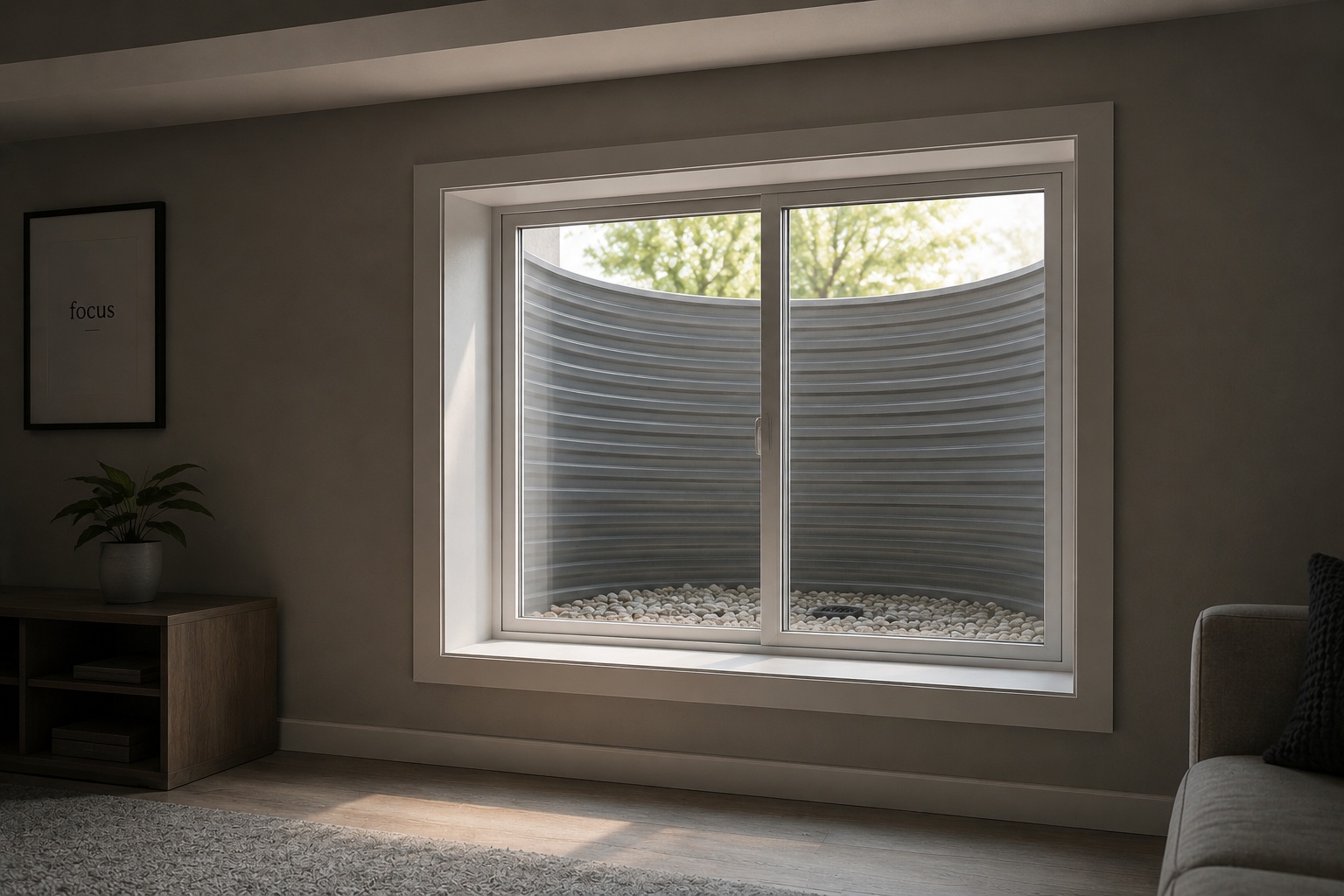
If you're finishing your basement and plan to include a bedroom — or if you want to legally call any basement room a bedroom — you need to know about egress windows. They're one of the most misunderstood parts of the basement finishing process, and getting them wrong can cause major problems when it's time to sell your home.
After 25+ years installing egress windows across Boulder, Longmont, Erie, and Firestone, here's everything you need to know.
What Is an Egress Window?
An egress window is a window large enough for a person to climb through in an emergency. In a basement bedroom, it provides the only safe means of escape if the stairway is blocked by fire or smoke. It's also the means by which a first responder can enter a basement to rescue someone.
"Egress" simply means "exit" — so an egress window is literally an exit window. The International Residential Code (IRC) and Colorado building codes require them in every room used as a bedroom below grade.
When Is an Egress Window Required?
In Northern Colorado, an egress window is required in any basement room that will be used as a sleeping room (bedroom). This means:
- If you want to list a basement room as a "bedroom" on your home listing, it must have egress
- If someone sleeps in the room regularly, it legally needs egress — even if you don't call it a bedroom
- If you're building a basement ADU, egress in the bedroom is required by law
- Family rooms, home offices, gyms, and game rooms do not require egress — only sleeping rooms
Here's the real-world impact: if you try to sell your home and a basement room is marketed as a bedroom without egress, the buyer's inspector will flag it. The deal can fall through or you'll face a costly last-minute installation under pressure. We've seen this happen many times. Do it right during the finish.
Colorado Egress Window Code Requirements
Colorado follows the International Residential Code (IRC) with some local amendments. Here are the minimum requirements that apply in Boulder, Longmont, Erie, and Firestone:
Minimum Opening Size
- Minimum net clear opening area: 5.7 square feet (820 sq in)
- Minimum net clear opening height: 24 inches
- Minimum net clear opening width: 20 inches
- Maximum sill height from floor: 44 inches
These measurements refer to the clear opening when the window is fully open — not the overall window size. The window frame itself will be several inches larger on each side.
Window Well Requirements
Because basement egress windows are below grade, a window well is required to allow the window to open and provide a usable emergency exit space. Colorado code requires:
- Minimum horizontal projection from the window: 36 inches (most jurisdictions)
- Minimum width: at least as wide as the window, typically 36+ inches
- If the well depth exceeds 44 inches, a permanent ladder or steps are required
- Drainage at the bottom to prevent water accumulation (a gravel bed or drain line)
- A cover or grate is optional in most jurisdictions but highly recommended
Local Variations
Boulder City: Boulder follows IRC closely but has additional requirements around energy performance and framing for historic homes. Always confirm with Boulder Building Inspection before ordering windows.
Longmont: The City of Longmont requires a permit for all egress window installations and inspects the rough framing before the window is installed.
Erie: The Town of Erie Building Department follows standard IRC requirements. Newer construction homes in Erie often have window rough-openings already sized for egress — check your framing before assuming.
Firestone/Frederick: Weld County and these municipalities follow IRC standards. Permit processing is typically faster than Boulder County jurisdictions.
The Egress Window Installation Process
Installing an egress window in an existing basement is a significant structural project — not a DIY job. Here's exactly how we do it:
Step 1: Assessment & Design
We assess the foundation wall type (poured concrete, concrete block, or wood), identify the best location (avoiding utility lines, structural posts, and neighboring property setbacks), and design the opening size to meet code while fitting the aesthetics of the room.
Step 2: Permit Application
We pull the building permit with the local jurisdiction. In Boulder, Longmont, Erie, and Firestone, a permit is required for egress window installation. We handle all paperwork — you don't touch the building department.
Step 3: Excavation
We excavate the exterior window well area. This involves digging down to the correct depth, hauling away soil, and installing gravel drainage at the bottom of the well.
Step 4: Core Cutting
For poured concrete foundations (most common in Northern Colorado), we use a diamond saw to precisely cut the concrete wall opening. This is a skilled operation that requires proper equipment to avoid compromising the foundation.
Step 5: Lintel & Framing
After the cut, a steel lintel beam is installed above the opening to carry the structural load of the foundation wall around the new window opening. This is a critical structural step that must be inspected.
Step 6: Window Installation
We install the egress-compliant window unit, properly flash and waterproof the opening, and install the window well surround.
Step 7: Inspection & Interior Finish
The city inspector confirms the installation meets code. We then finish the interior — drywall, trim, paint — so it looks like it was always there.
How Much Does Egress Window Installation Cost in Northern Colorado?
In our experience installing egress windows across Boulder, Longmont, Erie, and Firestone, here's what homeowners typically pay in 2026. Every situation is different, which is why we offer free on-site estimates — but here are the three most common scenarios:
- Window replacement (code-compliant swap): Starting around $2,500 — swapping out an existing window for a new code-compliant egress unit in an already-sized opening.
- Making an existing window code compliant (enlarging opening): Starting around $5,000 — expanding an undersized opening in the foundation wall, new lintel, and installing a proper egress window.
- Adding a brand-new egress window: $10,000–$15,000+ — full installation including permits, exterior excavation, drainage/gravel bed at the bottom of the well, core cutting, lintel, window well, and interior finish. This is the complete turnkey price.
Boulder City tends to be on the higher end due to permit fees and labor costs. Firestone and Frederick typically come in at the lower end of each range.
Egress vs. Non-Egress Windows: Can I Use an Existing Window?
Many homeowners ask whether their existing basement windows can serve as egress. The answer depends entirely on the size. Most original builder-grade basement windows are "hopper" windows — small, horizontal, and nowhere near egress size. You'll need to measure the clear opening when fully open. If it doesn't hit 5.7 sq ft / 24" height / 20" width, it doesn't meet code.
Occasionally we find newer homes where the rough opening was built to egress size but the window was never upgraded. In those cases, we can install a new window without cutting the foundation — significantly reducing cost.
Is an Egress Window Worth It Even Without a Bedroom?
Yes — and here's why many homeowners install them proactively even when not required:
- Resale value: Any basement room with an egress window can be marketed as a bedroom, immediately increasing your home's perceived bedroom count and value.
- Safety: Even in a family room or gym, an egress window gives occupants a safe escape route in a fire emergency.
- Natural light: Egress windows are large — they flood a dark basement room with daylight, dramatically improving the feel of the space.
- Future flexibility: Installing it now costs much less than cutting it in later after walls are drywalled.
Need an Egress Window in Northern Colorado?
We install egress windows to code across Boulder, Longmont, Erie, Firestone, and all surrounding areas. We handle permits, excavation, core cutting, framing, waterproofing, and interior finish — completely turnkey. Free on-site estimates.
Frequently Asked Questions
Not recommended. Cutting a foundation wall requires specialized diamond-blade saws, structural knowledge to install a proper lintel, waterproofing expertise, and a building permit that requires inspection by a licensed contractor. DIY attempts often result in structural damage, water infiltration problems, or failed inspections. The liability risk alone makes professional installation the only sensible choice.
Most single egress window installations take 1–2 days for the structural work, plus a few days for permits and scheduling inspection. From signed contract to completed project, expect 2–3 weeks total — most of that is permit processing time, not actual work time.
No — when done correctly by a professional with proper structural supports (lintel installation), cutting a window opening does not weaken your foundation. The lintel redistributes the load that the removed concrete was carrying. This is standard practice in basement construction and has been done safely for decades.
Yes. We can enlarge existing undersized windows to meet egress requirements. The process is similar to cutting a new opening — we expand the existing rough opening in the foundation wall to the required size, install a new lintel to span the larger opening, and install an egress-compliant window. This is often slightly less expensive than cutting in a completely new location.